Great Stories of the "O Fila" monthly Bulletins


The First Bulletin called "O Fila" published by the Commission for the Improvement of the Fila Brasileiro breed was issued in December of 1978, after its creation in March of the same year, in Sao Paulo. 

There is so much historical material contained in these bulletins, that it feels like a special treat to read. I consider this collection to be the "big book" of the Fila. Most of the articles were written by Paulo Santos Cruz himself. Much of it contains very thorough real science of those times, which ranges from genetics and anatomy;  to "How to's" of kennel construction, complete with an architect's project.

Interspersed with the technical articles about the Fila named "O Curso" [The Course], there are very informative articles about the evaluation of important Filas, results of the shows of the times, names of dogs and owners included and my personal favorites, stories of Filas!

Here are some excerpts from the article "O Fila, Boiadeiro, Onceiro e Amigo"
By Paulo Santos Cruz ["The Fila, The Cattle-driver, the Jaguar hunter and the friend "

The article starts right in with: "Dunga do Parnapuan foi o primeiro canino brasileiro exportado. Foi adquirido pelo príncipe da Baviera, Herzog Albrecht von Bayern." 
[Dunga do Parnapuan was the first Brazilian canine to be exported. He was acquired by the Prince of Baviera, Herzog Albrecht von Bayern.] (picture of the prince holding Dunga below)

Mr. Cruz, proceeds to recount the story of how the dog who was born at the shore town where his kennel was located, arrives in his new home in the middle of prussian winter. After having been kept for 3 months inside the prince's Castle to be spared from the brutal cold, the dog was released to the fields during the thaw, at 6 months of age. 


(original picture of Fila with Buffalo in "O Fila")

The first thing he sees is a grazing bull, which he then rushes to hold by he nose with his teeth, as he tries to bring it down. The Prince was so impressed and enthusiastic about the event, that he sends Paulo Santos Cruz a cablegram recounting the story in detail. 

He explains that Dunga was born at his kennel in Santos [Santos is a Port city near Sao Paulo in Brazil, people that are born and raised there are referred to as "peixeiros", meaning "for the fish"] as well as both his parents, however both his grandparents had come from Minas Gerais, at very very early ages. It baffles Paulo Cruz that Dunga should have such a reaction being that he was so far removed in time and environment from his ancestors, having only his great-grandfather been a cattle-dog. 

   It is plainly clear how important to Paulo S. Cruz genetics and the inheritance of traits were, being that in every issue of the first bulletins there is mention and  technically precise pages of articles about genetics.  He asks some questions that are still unanswered today, despite our much more advanced molecular technology:

Genes transmit only somatic and physical characteristics, therefore, which is the vehicle that transmits that which we call instinct? In which molecule, atom or particle does courage get passed on from ascendents to descendants? Where is the figure of the Bull archived in the mind of the Fila? And where is the physical or chemical molecule that starts the gears which signal it's brain that that bull is the one archived and also the file in which how to handle the bull is written.. These questions are unsettling because they show us how genetics is still taking baby steps.

He was such a forward thinker, that I believe that if he were alive today, he'd take into account Neuroscience and Psychology.


He also recounts a story about another Fila of his, used as an extra for a feature film of the Vera Cruz studios called "Sinhá Moça" [a slave term for a young woman, daughter of a master - "young m'am"]. They needed Filas to play the part of dogs to go after runaway slaves, so Paulo S Cruz sends in Aimoré do Parnapuan. Every time they slate the picture,  Aimoré wants to "get" the slate person. The director, Tom Payne tells Paulo that one day the dog started to pick up a scent in the air, which made him stiff and his hackles raise. At this point Martinelli, the animal wrangler for the movie, lets Aimoré take him to where the scent is coming from, only to find a jaguar in a cage. He immediately jumps on the cage and startles the jaguar which then cowers to the back of the cage. 

(original picture from the "O Fila")

Aimore was also born in Santos, but his parents were from Varginha and Nova Lima, Minas Gerais, and taken to Santos at around 2 months of age. Again Paulo S Cruz, questions about Aimore's onceiro [jaguar hunter] genetic Inheritance.. 

He tells the stories of how cattle was driven from the Mato Grosso swampland or the plains of Goias to the slaughterhouses of northern Sao Paulo state, a journey that would take weeks. Facing ever present danger, man and dog become brothers by taking on the same jobs and risks . He describes the cur-style in which the dogs and cowboys work in:
To listen to the the call of the man, in a large gesture in extended arm, asks the dogs to circle the stock to push it to move left or right.. After the job is done, the stock is parked and kept by circling around the herd and keeping it stationary. After fires are lit, man and dog eat and sleep together, keeping a close eye on each other and on the stock. 

(Filas from Farmland in the south of Minas Gerais)

He finishes this wonderful article with this lovely thought:
..kept in the cells of the pure-bred Fila are the Cattle-dog, the Jaguar-hunter, the friend, the cattle-driver, the fight against the big cat, the protection and guard of the man that knew how to be its master and friend, comrade and brother. 
Mastiffs my come from civilized land, but, precisely because of it, their cells did not get that which makes us love the Fila Brasileiro.

Many generations later, the Fila still defies time and odds, by showing us it is still capable of being a cattle dog and a hunter, as well as a guardian. Even with the advances of molecular science and neuro-biology, we still cannot pinpoint how behavior traits get passed  on, but the Fila has shown to be capable of adapting well to its original environment. 


Abare Boiadeiro do Jatoba and Gameleira Gitana dos Tabayara 2010


Present day Farm Filas in Minas Gerais, Brazil, 2010 (photo by Robson Freitas) 


for the full article look up "O Fila" Year II. Number 18, May 1980
(all pictures are linked to their original sites whenever possible and are for didactic puporses only-no intent of copyright violation was intended)

The Fila Brasileiro Breed Manifesto

manifesto

WE ARE RE-ISSUING THIS MANIFESTO IN FACE OF THE NEED FOR IMMEDIATE ACTION!!


zumba de parnapuan
Preserving the Fila Brasileiro – A Matter of Principals!
by Antonio Carlos Linhares Borges

This manifesto is addressed to all those who somehow can be responsible for breeding the Fila Brasileiro, and for the maintenance of this breed, domestically and abroad, as well as to hobbyists and enthusiasts. What motivates me especially; more than the simple fact of being a Fila breeder,  is being a Brazilian with high esteem for it. This was the sentiment that certainly led me to embrace the cause of conserving this genetic heritage, capable of marveling so many around the world for its extraordinary talents.

For over 30 years I have been studying and trying to understand the mysteries of the origin of this dog, of its creation in our national territory, and the characteristics that we understand as being unique, particularly inside the world of show dogs.

My interest in the preservation and knowledge of the Breed, was awaken by the advent of Cafib lead by Santos Cruz, with whom I learned the beginnings of preservation promotion. With the help of friends, and scholars, aficionados, and often simply admirers and owners of farms that have long bred and raised [the Fila] in their families for many years, I traveled thousands of miles through country roads and secondary roads, I personally photographed, filmed and watched those wonderful dogs at work, in action and in their habitat.

I sought out books, teachers of the genetics of dog breeding, of dog sciences, I studied the history, geography, Folk customs of the countryside of Minas Gerais during many late nights  - talked and asked questions. I learned something, though much of the mystery still remains, and perhaps will remain forever.

At all times, I never settled for the attempted dilapidation this heritage, and sought by the release of my book "Cao Fila Brasileiro – A Preservacao do Original" [The Fila Brasileiro Dog – Preservation of the Original] to pass along some guidelines for new breeders about what to preserve and what not to allow to sneak into their breeding programs.

Upon finishing the book, I had in Eugenio Henrique de Lucena's testimony; the former president of CBKC - Confederação Brasileira de Cinofilia, evidence that the introduction of other breeds in the Fila breed (cross-breeding) was in fact an undeniable reality: "... Since no one hesitated to introduce the bloodlines of other breeds, for example: searching for greater more size, [with] Great Danes, or mass and bone structure by using the Mastiff, the Neapolitan Mastiff and the St. Bernard. This unqualified practice was directly responsible for the lack of homogeneity found currently within the breed and the object of heavy criticism from foreign officials that visited us” (pag. 7). This is a declaration that we can consider to be an official declaration from the CBKC.

Moving away a little from the show dogs circuit due to personal affairs after the book release, until recently, I thought that the period of the ostentatiously atypical dogs having signs of the criminal crossbreeding that ravaged our breed, would have passed.

Also, recently, I was concerned about finding a way to contribute to the enhancement of the Fila Brasileiro, in order to eliminate small defects of type and select desirable characteristics. A job that led me to find and socialize with friends that I cherish; who I both respect and admiration for their dedication and success in breeding in the Unifila Club.

However, prompted by other combatants against crossbreeding - which I thought exaggerated in their position, or that they could be outdated, very recently - I found myself seized with fright, to receive photos of dogs of this era, so distorted from the original breed type; to point of almost not believing the official dog club (CBKC) would still enable and reward so many aberrations [freaks of nature]. We know that the human hand can alter breeds of their animals, imprinting characteristics at their whim. But we can never overlook that the ethics of preservation should prevail when it comes to historical heritage. It is not up for any agency created to support breeders to break with this ethos. What is fitting, rather, is the responsibility of maintaining this heritage untouched, out of respect for the people who produced it.

The Fila Brasileiro, as well as other national native breeds, does not belong to any [organized] group established for its breeding, but only to its country, its history and its saga of survival alongside the men who came to build this country. It is the duty of these so called official show dog agencies, represented by the CBKC, to respect the breed. The Ministerio da Agricultura [Ministry of Agriculture], should in fact, as it happens in other countries, take over their responsibilities to this heritage that came from the farms in Minas. Unfortunately, it does not and by that, disregards the importance of the cultural aspect that the Fila represents. By failure in doing so and avoiding this responsibility, these entities leave us few options - we breeders and hobbyists – but to express our reprisal about the situation represented in the environment of show dogs. Which is certainly still very little, because we cannot be satisfied only by expressing our discontent. This mistake cannot become truth by virtue of formalization.

We must react vigorously against the squandering of assets, not allowing that grotesque changes in the breed standard become established as true. If it were not a matter of preservation, would the "New Filas" be the result of apathetic improvement, devoid of knowledge about dogs and inadequate for performing of the job for which its proposes was for; of sometimes pachyderm-like dwarf legged deformities or monsters drowning in disfiguring double chins or sometimes tall legged having no support on the ground. Not knowing where to get with the production of these exotic specimens, shockingly different from the original natural and useful ones, so exquisitely designed by nature and from working alongside colonial farmers.

If they are raising exotic animals, then there should be transparency from breeder groups which are accountable to the dog breeding world (FCI) - recognizing them as a novelty, distinguishing them from the original animal and who knows, even by starting to establish a standard by itself. What would not be unprecedented nor absurd; because we have an example in what happened with the Mangalarga equine breed, which suffered similar intervention of experimenter-breeders and were crossbreed with various foreign breeds and came to generate the Mangalarga and the Mangalarga Marchador; separating the exotic from the original (Marchador). Precedents also exist in dog breeding, as is the case of the reaction of the Japanese, which were forced to separate the breed standard into Akita and the American Akita, altered until they became unrecognizable by breeders of origin.

What we cannot do in any way is admit the tower of Babel; the multiplicity of types, as the representation of the breed. Thus, yes, reason to become the laughing stock of the entire show dog world; that is, if they are even wanting to "appear to be" something.

Here I take the liberty of considering myself qualified for the manifestation of indignation, because the way these facts appear, they offend the entire content of knowledge I've acquired over years of study and fieldwork that I conducted. However, to become indignant with such overwhelming and undeniable facts, certainly shall not alter or affect the structures of historically apathetic societies, ommissive and indifferent to events of this nature within the Fila Brasileiro breed.

I propose here, in front of a whole community of FB breeders, all organizations and individuals, unhappy with the continuation of the existing heterogeneity within the breed until the present and following the introduction of other breeds (as stated by the former President of the CBKC Eugênio Henrique Pereira de Lucena);  the beginning of a cycle of discussions on what to do / what actions to take in face of this framework.

In my view, it is impossible to live with this situation any longer.
Certainly, we who practice the breeding of what may be termed the Original Fila Brasileiro, which we all know well what is. And on the opposite side, a modern fila, still under construction and from what I understand, in search of a standard; perhaps an identity, by part of a group of breeders - a minority that insists on error! We now have a strong community of breeders - preservationists who struggle for the Fila to remain unchanged in its most basic characteristics by preserving its original utility both in mental qualities and in instinctive capacity as well as in physical specifications. I take the liberty of calling the leaders of the clubs that work with the preservation of this original type, to urgently volunteer your areas of operation and call on all your members and breeders with the aim of opening extensive discussions in search of a solution to this situation.

What I propose is more than a reaction, it is the delivery of a document prepared by a whole community of preservationists of the Fila Brasileiro addressed to the governing bodies of dog breeding world, with a proposed solution. I think any proposal to resolve this issue that warrants any legitimacy, has an obligation to start from breeders and that a significant portion of these breeders represent the desire of a majority.

I will make myself available to mediate discussions, seminars and forums in search of drafting a document that can be forwarded to the relevant bodies as a claim made by a preservationist class.

I am sending this manifesto (at the same time as challenging breeders) to all addresses available to me, requesting that all admirers of the Original Fila Brasileiro post this on their sites and send it their friends.

I hope the specialized clubs committed to the cause of preserving this dog breed also may position themselves.

In order show an example about what I mean when I talk about the diversity of the Original Standard, a sequence of photos and comments is attached and which can be compared to the Filas still faithful to the traditional Standard of origin.

Governador Valadares,
January 2010. [printed in English in June 2011]
Antonio Carlos Linhares Borges
Creative Commons License
The Fila Brasileiro Breed Manifesto by Antonio Carlos Linhares Borges is licensed under a Creative Commons Attribution-NonCommercial-NoDerivs 3.0 Unported License. Based on a work at www.canilcaramonan.com.br.


--------------------------------------------------------------------------------------------------------------------------------------------------------
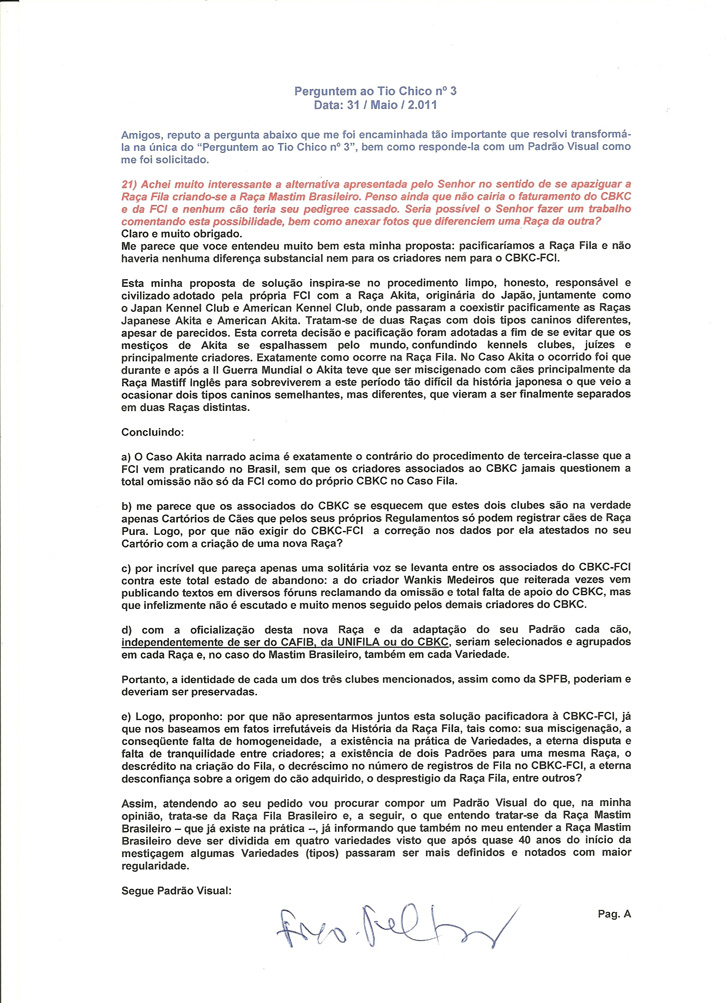
To see the proposal made by Chico Peltier click here, for a comprehensive photo-guide click here

Please leave your comments or suggestions. 
Join our facebook group !
Join our online Manifesto event and to help mobilize a solution!  
Post this Manifesto on your site and send it your  friends. Let's get this party started! 


Abracadabra! The Smoke & Mirrors Show..


 We do not believe that all our fila brasileiros are excellent or that they are the best, not in any way, we are cognizant that we have dogs of excellent quality, of average quality and also occasionally a few of poor quality, which we seek to remove from procreation. Excerpt from "The Contradictions and Inversion of Values in the fila brasileiro Breed", by CBKC judge Virgilio Orsi  How do you justify the  2010 (CBKC) Brazilian National Best in Breed  Champion, Mr. Orsi? By the way, the bitch is currently expecting a litter.


It is believed and commented in certain circles that if those who have dogs with mix-bred traits start a program of continuous matings with very typical Filas, indicated by the CAFIB, that the number or pure-bred (or almost pure-bred) dogs would augment in very little time.

Such a notion was countered by Dr. Anibal Felipe da Silva, an animal reproduction expert, with extensive understanding of canine DNA and who heads a pioneer study on the genealogy and DNA of the Fila Brasileiro: "ONLY IF IT WERE supervised by the geneticists from our Army, the Police Force and Federal Universities (preferably the very traditional ones which have blind replicas of material) and based on DNA tests ALONG AT LEAST 32 YEARS (ie, eight generations with a Generational interval of 4 years).
As this is economically unfeasible and even ridiculous to propose, considering the thousands of other priorities that Brazil has to tackle,  I say that I find nothing healthy in this proposal, since it will lead to more confusion to many unsuspecting breeders as well as to the less careful experienced ones who insist on not using frequent DNA tests in their breeding programs, if only to prove its genealogy ...

[Breeding] Going only by pedigree is very, very, very, little information."

It is a startling awareness when one considers the amount of years of unregulated mixed-breeding practices. Initially done with the original pure-bred dogs from known breeds, such as the English Mastiff, the Great Dane (more specifically the black great Dane) and the Neapolitan Mastiff. Since March of 2011, breeders in high positions in dog clubs associated to the Brazilian CBKC [which in turn is associated to the FCI - an International Dog Club that issues international pedigrees and holds shows], have been voicing public statements recognizing that this mix-breeding did in fact occur. What they do not take into account, or maybe intentionally detract attention from, are the countless numbers of dogs bred from the initial hybrids and 40 years of subsequent generations of crossings of their mixed-breed off-spring. Done openly with no supervision or orientation from geneticists as well as records of such practices in the official dog Club's books.
Time has come for this new brand of breeders of the Official Dog Club of Brazil, to find themselves in a very tight corner, unsupported and disenfranchised by the club they have always stood by unconditionally. 

The CBKC recently has been the target of many breeder's public complaints, ranging from cancellation of National show events to high fees and lack of services. They have also been removed from their position as the government appointed "registrar book keeper" of ALL canine breeds [once held exclusively by the CAFIB for the Fila Brasileiro breed], by the governmental agency known as the Ministry of Agriculture, Livestock and Provisions. Apparently, they have also done a very bad job keeping the government interested in dogs as a viable form of revenue, and worse, they have totally neglected Native Brazilian breeds (among them one of the highest grossing in revenues from registries); some of which have become extinct for lack of support and organization. Adding to that, the inability to produce homogeneous dogs having the behavior characteristics described in the breed's standard, a strikingly noticeable difference between types of dogs can be seen in their specialty shows,  led these breeders to purchase dogs from CAFIB members and kennels, in the hopes of producing the next new and improved Fila Brasileiro knock-off.

So, step right up and welcome to the Smoke & Mirrors show of the new found brand of the CBKC.. A show that is put together by the folks that still support the breeding ethics of the likes of Procopio do Valle and his disciple Clelia Kruel in the United States and in which the new brand of  "breeder magic" make the illegal and uncontrolled mixed-breeding done by their mentors & years of hostility against the CAFIB,  appear or disappear by extending or retracting mirrors amid a confusing burst of smoke up our asses..


Are we Standing in Face of a Paradigm Shift?

Breaking News: In a heated discussion on a Brazilian Orkut Fila Brasileiro group on the topic about the controversial cross-breeding involving the Fila Brasileiro breed, Fila Brasileiro & Mangalarga horse Breeder, high-school educated, self entitled,"empresario"- admitted:
QUOTE: Eu acredito que devidos a vários fatos, deve ter ocorrido mestiçagens na década de 70... [I believe that because of several facts there must have occured mixed-breeding in the 70's]
END QUOTE
Harrison Pinho - ex canil Arere/curently rebranded Canil & Haras Singular, April 3, 2011

This quote had been copy and pasted many times by group members who recognised this admission as a victory. A few hours later he removed this statement..Oh well..


Have a good trip Harrison and all that are "taking the train" to Minas again.. 
Thiago Rodrigues Gonçalves, up and coming breeder, Canil Fila Roots, Brasilia


Mr. Pinho aligns himself with a growing number of followers of the CBKC that are "going back to Fila roots" and procuring Filas in the kennels of Minas Gerais - the birthplace of the Fila Brasileiro. Those kennels are consistent participants and prize winners of the, once seen as dissident  club's [CAFIB] shows and trials, known to the fancy as "expos".  He has also stated publicly that he has acquired new dogs from these kennels to aggregate to his current breeding stock. A move he kicked off by re-branding his kennel as "Singular". Many Fila enthusiasts and supporters of the Cafib dog club view his come-back as opportunistic and having a hidden commercial agenda, others embrace the newcomer to the world of the true-bred Fila. Mr. Pinho revisits breeding dogs, just as the Cafib is at an all time popularity high due to its system's enormous success rates in breeding results.

Mr. Pinho follows in the footsteps of other breeders, such as Mr. Roberto Sena Sene (canil Sena Sene), veteran in the practice and Mr. Wankis Medeiros (Canil Fortal do Fila)who have both implemented the philosophy of improvement of their breeding stock with the genetic traits and qualities of these the product of these once frowned upon kennels. However, also keeping a foot in the CBKC-safe zone, for guaranteed sales.

What they have not done [yet] is taken the full plunge such as the courageous breeder of the Canil Borghetto has. Dr. Carlos Eduardo Goncalves, veterinarian, heir and current administrator of the New Age  Borghetto kennel (a very well known name in the USA),  has started over by scratching the old and "questionable" breeding stock altogether, replacing it with a brand new crop of very promising dogs from well-known archetypal Brazilian Fila bloodlines, as well as a very progressive mindset and hope in a future, which includes taking practical steps such as: participating in Cafib Analysis of Phenotype and Temperament trails, DNA testing and inclusion in the Fila Brasileiro National Database, as well as proper health screenings.

It has been a [very] slow but steady pace for positive change for the breed, nonetheless, it has been consistent and strong, supported by the foundation of the philosophy of Paulo Santos Cruz and the Cafib system, format and mentality of improvement and betterment of the dog breed. However, it hasn't been a process without consistent aggressive and unfair resistance.

Needless to say, it is a process already in motion, with much more to be revealed in all fronts. This change in attitude, adopted by Dr. Carlos Eduardo Goncalves, will very likely become the new paradigm of successful and wholesome Fila Brasileiro breeding.

Breeding Out the Facts...


"However, my friends, I must confess that the picture that saddened me the most and brought me the most disgust in all these passionate 37 years was the one of the Fila attached to this message. This is true debauchery of the Fila breed. It is a mockery of a natural feature of the Fila Breed, not found in any other breed and Standard: the OJERIZA. This means: "aversion, dislike, feeling of disgust or revulsion by people or things.

The photo [above] was taken recently at SICALAN (La Sociedad de Intercambio Cinofilia Latinoamericana) and shows the total breakdown in temperament, character, personality and nature of a true Fila Brasileiro. A real Fila that has a typical temper would never let himself  be felt up by a judge, who is nothing more than a stranger to him. Look at this picture where this fila meekly allows the judge to put his hand (no gloves) inside its mouth. Friends: within their tool of defense and attack! Forgive me the SICALAN, this Lady and this judge so elegantly dressed, but this photo depicts a depressing and repulsive moment in the History of the Fila.

Chico Peltier, 2011